What do you need to learn when you’re a young giraffe?
How to use those very long legs? Check.
How to follow Mom? Check.
How to grow taller and taller and taller? Jasper seems to have that one covered.
But at the Columbus Zoo and Aquarium, young Masai giraffe, Jasper, is learning another important set of skills: how to participate in his own care.
Welcome to giraffe school!
Meet Jasper
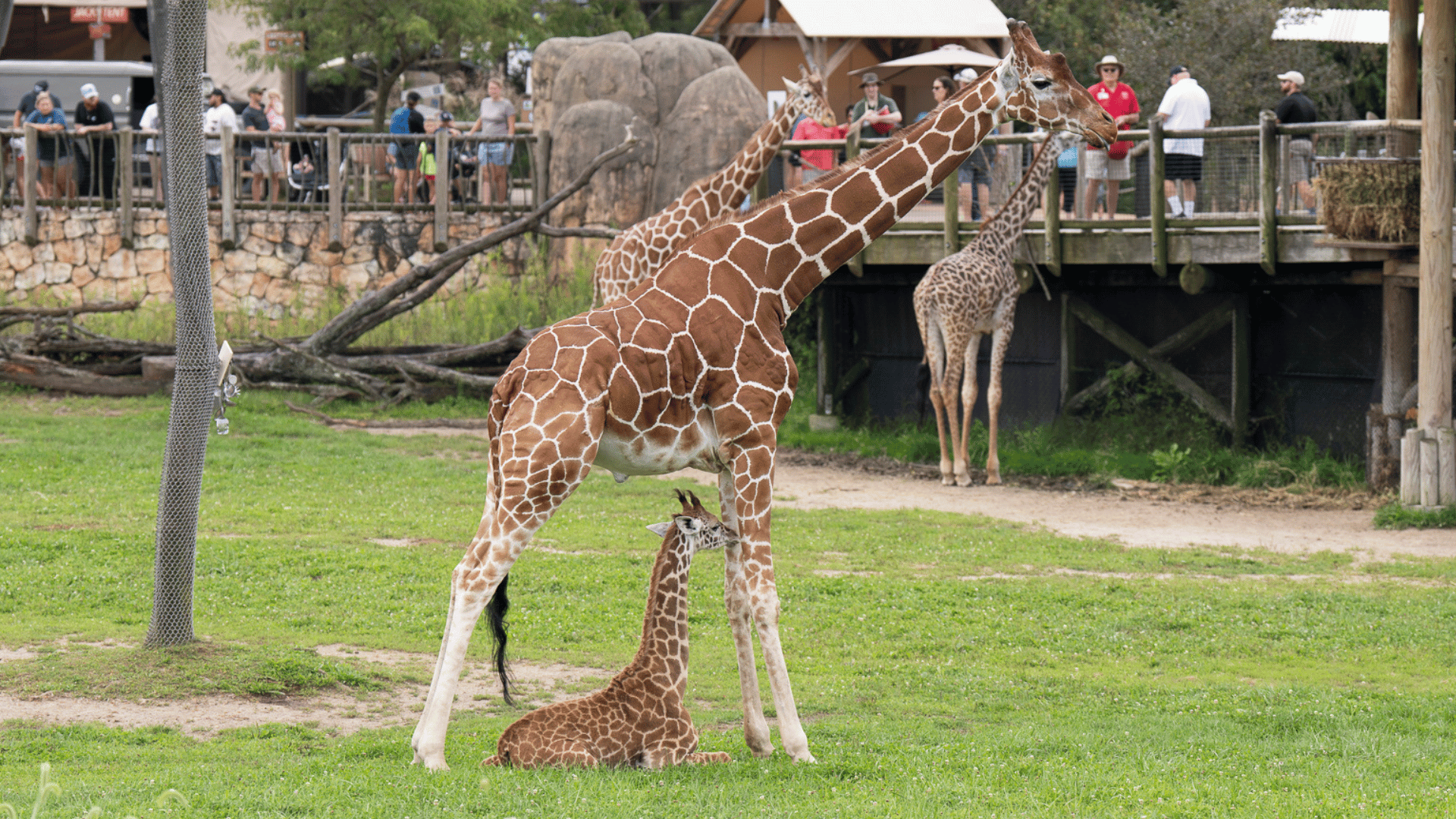
Jasper’s story at the Columbus Zoo began on March 10, 2026, when he was born at 6:16 p.m. in the Zoo’s Heart of Africa region. His mom is Zuri, a 15-year-old Masai giraffe, and his dad is Bobbie. Jasper is Zuri’s third surviving calf born at the Columbus Zoo and Bobbie’s first.
Jasper didn’t waste much time figuring out those extra-long giraffe legs! Shortly after birth, he stood, took his first steps and began nursing. A wellness exam by the Zoo’s Conservation Medicine and Animal Care teams found him healthy and well fed.
His birth was also important for the future of Masai giraffes. The subspecies is listed as Endangered by the International Union for Conservation of Nature (IUCN), with an estimated 43,000 remaining in the wild. Their populations have declined by nearly 50 percent over the last three decades due to habitat loss, poaching, civil unrest and environmental change.
Jasper’s parents were paired through the Association of Zoos and Aquariums’ Species Survival Plan®, or SSP, which helps accredited zoos work together to maintain healthy, genetically diverse populations of threatened and endangered species in professional care.
The Columbus Zoo also supports giraffe conservation efforts around the world and has raised more than $400,000 for giraffe projects since 2009.
Jasper may be one young giraffe growing up in Columbus, but he’s part of a much bigger story for his species.
Learn more about Masai giraffe The Zoo’s Impact Report
Growing Up Giraffe
When Jasper was born, some of his earliest lessons came naturally: standing, walking, nursing and staying close to Mom. Now, his education is getting a little more interesting.
His Animal Care team has begun teaching him behaviors that can help Jasper voluntarily participate in his own care. Someday, these skills could be useful for blood draws, hoof care, moving between different spaces and other important parts of keeping a giraffe healthy.
Starting while Jasper is young has its advantages. Young giraffes tend to be curious and can be more fearless about investigating unfamiliar things. His care team is taking advantage of that brave spirit by gradually introducing him to new people, objects, positions and places.
The goal is to help Jasper learn that working with his trainers is a positive experience. So, what exactly does a young giraffe learn in giraffe school?
Lesson One: Follow the Target!
First up: target training.
Jasper has learned to approach and touch a target when asked by his Animal Care team. It might sound like a simple assignment, but a target is an incredibly useful training tool.
Once an animal understands how to target, the Care team can use that behavior as a foundation for many others. It can help Jasper learn where to stand, where to move and how to position himself for different types of care.
Most importantly, Jasper is learning that choosing to participate in a training session leads to positive experiences. That lesson will become especially important as the little giraffe in front of his trainers becomes a much, much bigger one.
Lesson Two: What Are Those Straps?
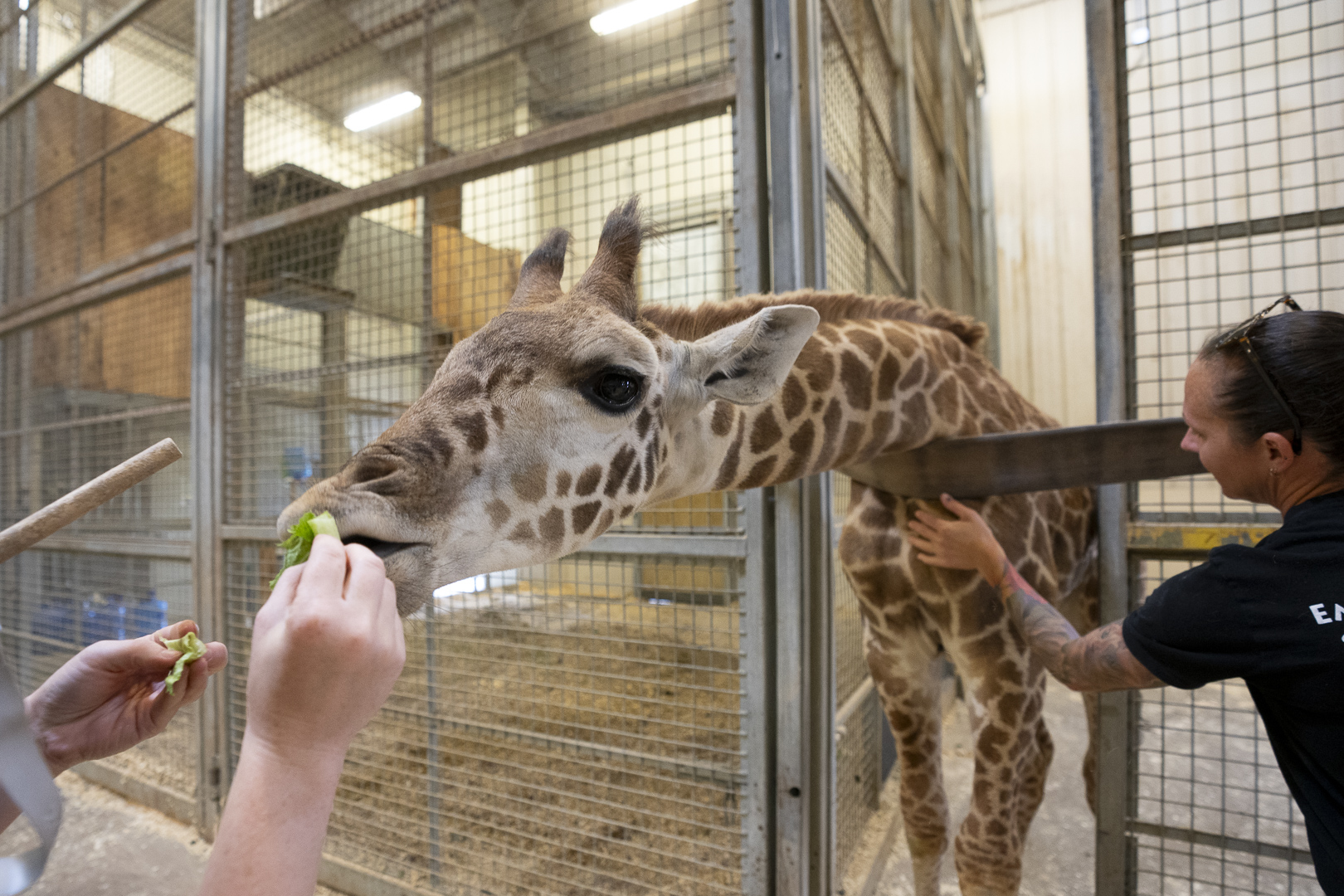
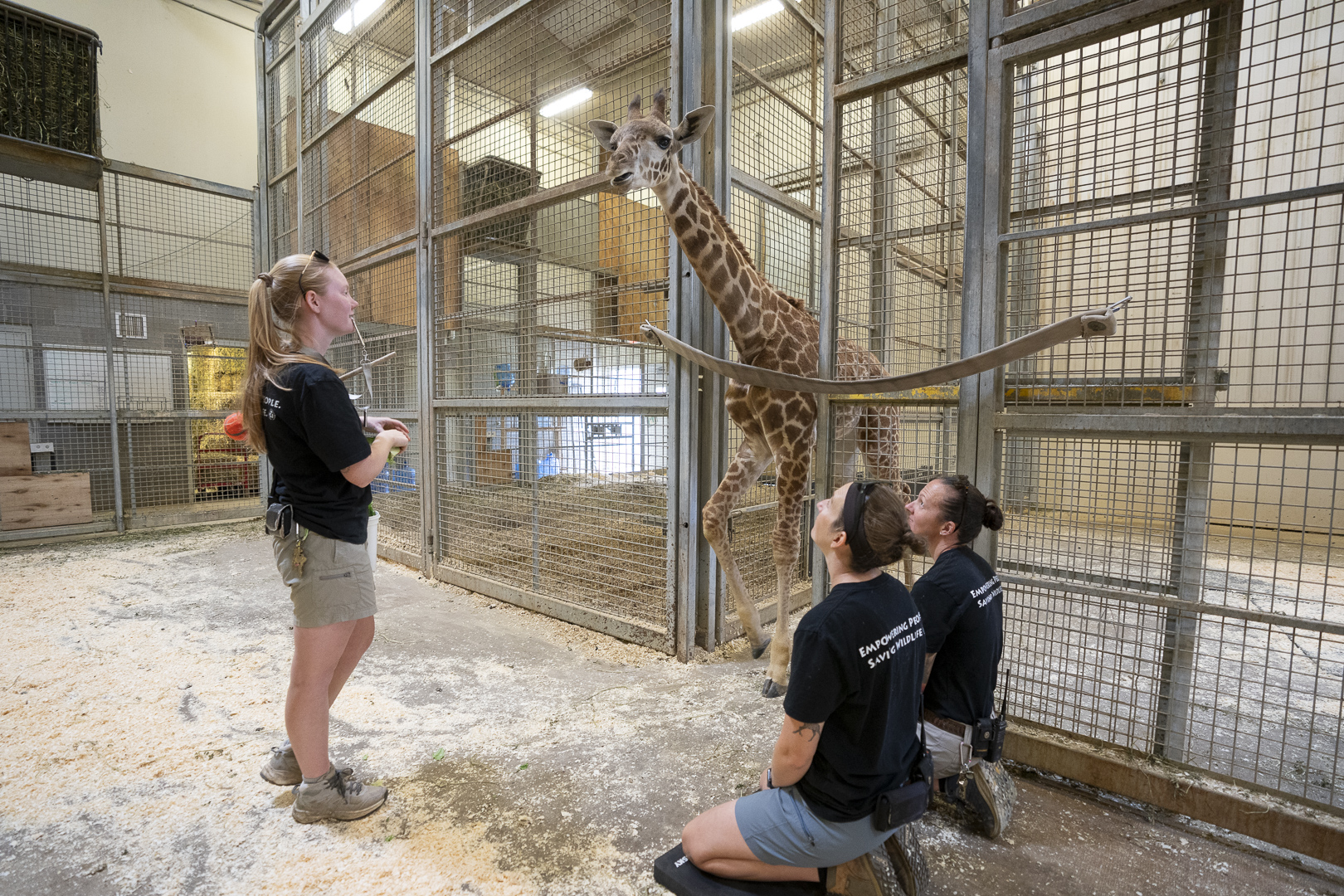
If you look closely at photos of Jasper training, you may notice a wide strap hanging in front of him. That’s firehose! Firehose straps are commonly used in giraffe training. Jasper is currently learning to comfortably approach and stand at the strap while his Care team works nearby. This setup allows Jasper and the team to safely share space during training.
And the setup will grow right along with him.
As Jasper gets taller, the straps can be raised to meet his chest, and an additional strap can eventually be added. For now, simply becoming comfortable approaching the straps is an important part of the lesson. Once he has that mastered, the team will begin building on it.
See other ways firehose is used at the Zoo
Lesson Three: Getting Ready for a Checkup
One of Jasper’s current lessons is getting comfortable with touch.
His team started by touching his neck and have gradually worked their way toward his chest. There’s an important reason to practice this particular skill: a giraffe’s jugular vein is located in the neck, and it can be used when blood needs to be collected. Once Jasper is comfortable with the Animal Care and Conservation Medicine teams touching his neck, they can gradually introduce some of the things he might encounter during a future blood draw, such as a blunted needle and syringe.
Each step is introduced slowly, allowing Jasper to become comfortable before moving on to the next one. Eventually, the goal is for Jasper to voluntarily participate in these types of healthcare procedures while awake.
A Blood Draw That Can Help Another Giraffe
Blood collection has an especially important connection to the Columbus Zoo’s giraffe herd.
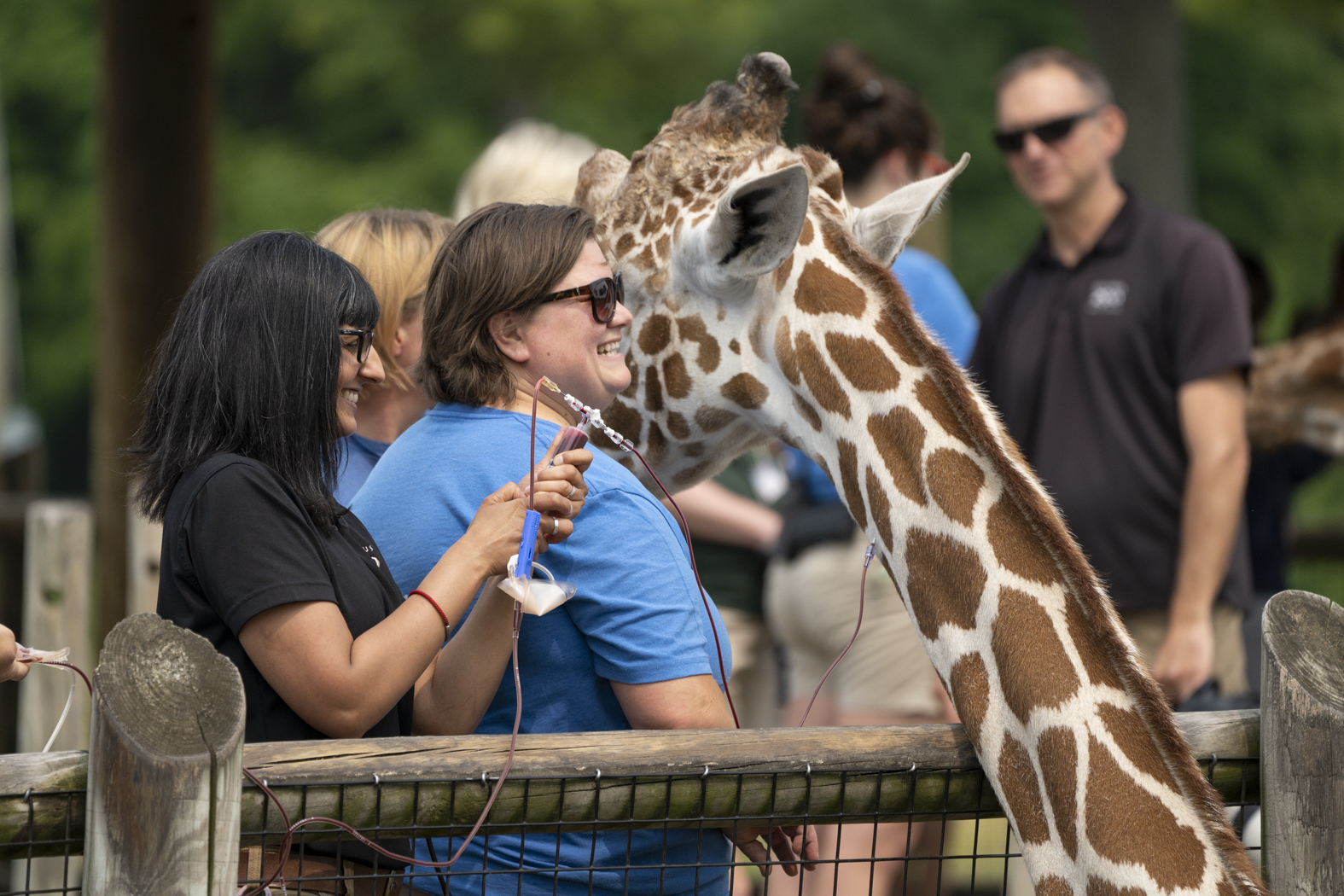
The Columbus Zoo and Cheyenne Mountain Zoo in Colorado are co-founders of a giraffe plasma bank. Along with other collaborating zoos, the teams collect plasma that can be sent to giraffes in need of a transfusion. Plasma contains important antibodies and proteins that can give a critical boost to a young giraffe’s immune system. These transfusions have helped save the lives of several giraffe calves across the country.
Here’s the really cool part: giraffes at the Columbus Zoo have been trained to voluntarily participate in these large-volume blood collections while they are completely awake! That kind of cooperation doesn’t happen overnight. It takes time, trust, positive reinforcement and plenty of practice.
The simple neck touches Jasper is learning today are the beginning of the same kind of foundation.
Lesson Four: Don’t Forget the Feet!
Jasper’s feet are on the lesson plan, too.
His Care team is gradually working their way down his legs so he becomes comfortable with the touches and movements that could eventually be involved in hoof care.
And when we say gradually, we mean it. During a recent training session, two members of Jasper’s care team knelt on pads beside him. Jasper had never seen his team in that position before, and he hadn’t encountered the pads they were kneeling on either. That made the pads a lesson of their own. Eventually, the team can introduce Jasper to a hoof block. There are several different versions they can use as they slowly work toward the goal of Jasper voluntarily positioning his feet for care.
Lesson Five: New People, New Places
Some of Jasper’s most important lessons don’t involve medical care at all.
He’s also learning how to comfortably move throughout the giraffe barn, including through the transfer chute. Jasper is getting used to seeing Animal Care team members, docents and volunteers. He’s learning to travel into different parts of the barn and even head to the shamba to eat. He’s also practicing staying focused on his trainers when the barn is busy and other things are happening around him.
All of those experiences help build resilience.
- A new person? No big deal.
- Something different on the floor? Let’s investigate.
- A busy barn? Jasper can still pay attention to his trainer.
The more positive experiences he has while he’s young, the better prepared he can be for the new experiences he may encounter throughout his life.
Every Little Step Counts
Jasper won’t learn everything in a day, a week or even a month. That’s part of the process.
His training is built around small, positive steps and his willingness to participate. A pad on the floor today could help prepare him for hoof care later. A gentle touch on the neck could someday help him voluntarily participate in a blood draw. Following a target could help him comfortably move exactly where he needs to go.
Right now, Jasper is still the youngster of the giraffe barn. But he has a whole lot of growing ahead of him. By building these skills and positive relationships now, his Animal Care team is helping prepare Jasper for a lifetime of safe, calm and cooperative care.