Scientific Name: Dacelo novaeguineae

Conservation Status: Least Concern

Size: Up to 17 inches from tail to the top of their head

Weight: Around one pound

Median Life Expectancy: Males 20.2 years; Females 18.2 years
Green tree background
Nutrition

Kookaburras eat insects and meat, including snakes, lizards, crayfish, frogs, small birds, and rodents. They swallow their food whole. If the prey is large, hit it against a branch to make it easier to swallow.

At the Zoo, kookaburras eat mice, mealworms, and a specialized ground meat diet.

Current Range and Historic Range
This species can be found in eastern and southern Australia. It has more recently been introduced to Tasmania and New Zealand.
Habitat

Kookaburras live in eucalyptus forests and woodlands that are often wet and cool. They like leafy trees and can be found near rivers, lakes, and even in parks or gardens.

Predators and Threats
Laughing kookaburras have many predators. Large birds of prey, like eagles and owls, hunt both young and adult kookaburras. Chicks and eggs can be eaten by snakes, monitor lizards, and quolls. In towns and cities, animals brought by people, such as foxes and cats, are also a danger.
 
This species is threatened by habitat destruction and fragmentation, particularly by the clearing of eucalyptus woodlands and the removal of old trees with nesting hollows.
Physical Characteristics and Adaptations

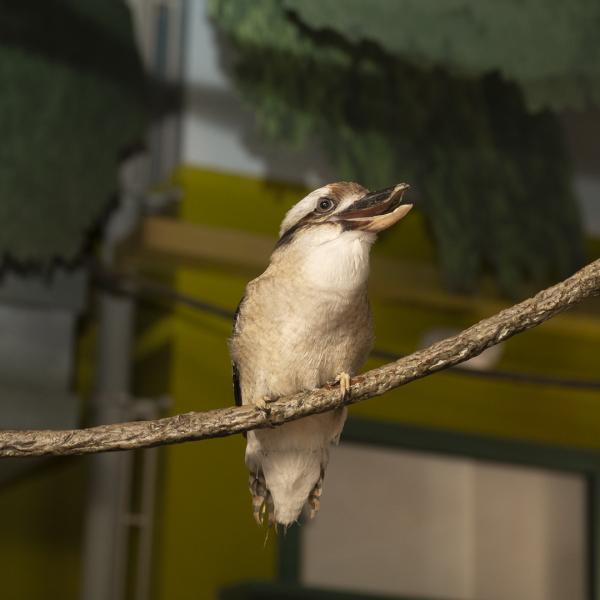
Kookaburras are large, strong birds. They have wide, square heads with brown spots on their cheeks and a dark line across their eyes. Their beaks are long and strong, which helps them catch and hold their food. Kookaburras have mostly brown feathers on top and lighter feathers underneath. Their tails are reddish-brown with dark stripes, and a small blue patch is near their back. These colors help them hide in eucalyptus forests, allowing them to wait and ambush their prey. Male and female kookaburras look almost the same. Their eyes are dark brown, and their legs and feet are pale greenish-gray. Young kookaburras are usually darker and have more stripes than adults.

Reproduction

Kookaburras are birds that stay with one partner for their whole lives. The adult pair often gets help raising their chicks from older siblings born the year before. They make their nests in holes high up in trees, usually about 30 feet off the ground. The mother lays two or three eggs in each clutch, with a day between each egg. After about 24 to 29 days, the chicks hatch. They are blind and have no feathers, but are already almost as big as adults. Both parents and the helpers feed the chicks. After about 32 days, the chicks leave the nest, but the adults and helpers keep feeding them for more than six weeks.

Kookaburras become adults when they are about one year old. Young females usually leave their families' area within one or two years. Young males stay longer, leaving after two to four years.

Communication

Kookaburras are known for their loud, laughing calls. Groups of kookaburras make these calls together early in the morning and again in the evening. Their laugh has several parts that can come in different orders, and sometimes some parts are repeated or skipped. Each part of the call can mean something different, like warning the group about danger or getting their attention. Kookaburras also make other sounds. They use a "chuckle" to stay in touch, a "chuck call" when feeding chicks, a "squawk" when being submissive, a "soft squawk" to show the nest, and a very loud "screech" when fighting.

Baby kookaburras start by making soft squeaks. As they grow older, their calls get louder. When they want food, young kookaburras use a soft squawk. At six weeks old, they try their first laugh, and by three months, they get much better at it.

Behaviors

Kookaburras are territorial, meaning they live in the same area year-round. They form groups of three or more, usually made up of a breeding pair and some helpers, who are often younger family members. These helpers, usually males, help build nests and protect the group.

Kookaburras sometimes fight to decide who is in charge. This is called sparring. During sparring, two birds lock their beaks and try to push each other. The fight stops when one bird leaves or falls off the branch. The breeding pair is always in charge, and the oldest helper comes next. Young birds learn who is boss by sparring when they are still young.