DOWNLOAD HIGH-RES IMAGES HERE. Photo captions are contained in the file name. Please credit all photos to the Manatee Rescue & Rehabilitation Partnership (MRP).
ORLANDO, Fla. - Multiple rehabilitated manatees—including seven manatees rehabilitated at the Columbus Zoo and Aquarium—have been returned to their native Florida waters following several years of care through the Manatee Rescue & Rehabilitation Partnership (MRP). For animals that began their journeys as vulnerable orphans and young manatees in need of long-term support, the releases mark a significant milestone.
The MRP is a cooperative group of non-profit, private, state, and federal entities that work together to rescue, rehabilitate, release, and monitor sick and injured manatees. Most of the manatees were originally rescued as small orphans or young animals affected by cold stress syndrome between 2022 and 2025 by the Florida Fish and Wildlife Conservation Commission (FWC) and MRP partners. Over the course of their rehabilitation, organizations including SeaWorld Orlando, ZooTampa at Lowry Park, The Seas with Nemo & Friends at EPCOT, the Columbus Zoo, the Cincinnati Zoo & Botanical Garden, Brevard Zoo, Georgia Aquarium, Clearwater Marine Aquarium, Clearwater Marine Aquarium Research Institute (CMARI), The Bishop Museum of Science and Nature, Mote Marine Laboratory and Aquarium, Florida Keys Aquarium Encounters, Zoo Miami, the U.S. Fish and Wildlife Service, the University of Florida, and Save the Manatee Club worked together to provide the long-term care needed to prepare these manatees for return to the wild.
The manatees were released at warm water sites in Florida, including Blue Spring State Park in Orange City, Crystal River, Warm Mineral Springs, and the TECO Apollo Beach power plant, where wild manatees congregate this time of year. Under the terms of their contract for services with the Manatee Rescue & Rehabilitation Partnership, Clearwater Marine Aquarium Research Institute (CMARI) will tag and monitor MRP-sponsored manatees following their release.
These expert monitoring efforts by CMARI help support a successful transition back to the manatees’ native range while alerting MRP partners if additional support may be needed. Every manatee returned this winter that is considered “naive” and does not yet have the necessary experience in the wild will be fitted with a GPS tracking device that allows researchers to monitor movements and acclimation to their natural habitat over the next year.
The MRP reminds those who may see a tagged manatee from their dock or while boating not to approach, follow, or interact with these animals, and not to tamper with the tracking gear. Young manatees with little experience in the wild must learn critical survival skills, including where to find warm water during winter, as well as food and shelter.
“The gear we deploy on manatees allows CMARI to monitor a manatee's movement and behavior. When an animal loses their tracking gear, we have no way to provide assistance or rescue needs if they become sick or are not adapting back into the wild. Their monitoring gear is their lifeline during this vital phase of recovery,” said Monica Ross, Director of Manatee Research and Conservation with the Clearwater Marine Aquarium Research Institute.
“These releases are the reason we do what we do. In the year that manatees Vora, Lilypad and Orchid were here, they each gained more than 250 pounds, with Orchid gaining almost 400 pounds. Our job is to get them to a releasable weight, and that is what we did. The manatees ate approximately 60,240 lbs. of lettuce during their stay at the Cincinnati Zoo, and we are so excited to see them start the next chapter of their lives swimming in their native Florida waters,” said Lindsay Garrett, Manatee Springs keeper at the Cincinnati Zoo.
“Manatees are an iconic species in Florida, and their conservation affects us all. As these sea cows continue to face significant threats to their survival, it is more important than ever that we dedicate our time, energy, and resources to securing their future,” said Tiffany Burns, Senior Director of Animal Programs at ZooTampa and President of the MRP. “Providing critical care to this incredible species benefits our state's ecosystem. We are grateful for the unwavering commitment of MRP member organizations. Their dedication enables us to rescue, rehabilitate, and safely return manatees to Florida waters, ensuring that these gentle giants can thrive for generations to come.”
The manatee releases come at a critical time for the species, as Florida manatees face ongoing natural and human-caused threats and highlight the importance of partnership efforts that extend beyond Florida.
“What’s special about the MRP is the way it brings organizations together through a coordinated network of partners, extending the reach of manatee conservation far beyond Florida. Caring for manatees here in Ohio also provides us with the opportunity to connect millions of guests with their story, helping people understand why manatees matter and what it takes from all of us to protect them. It’s incredibly rewarding to know our role helps support their journey back home and that their story can inspire action everywhere,” said Becky Ellsworth, curator of the Columbus Zoo’s Shores and Aquarium region.
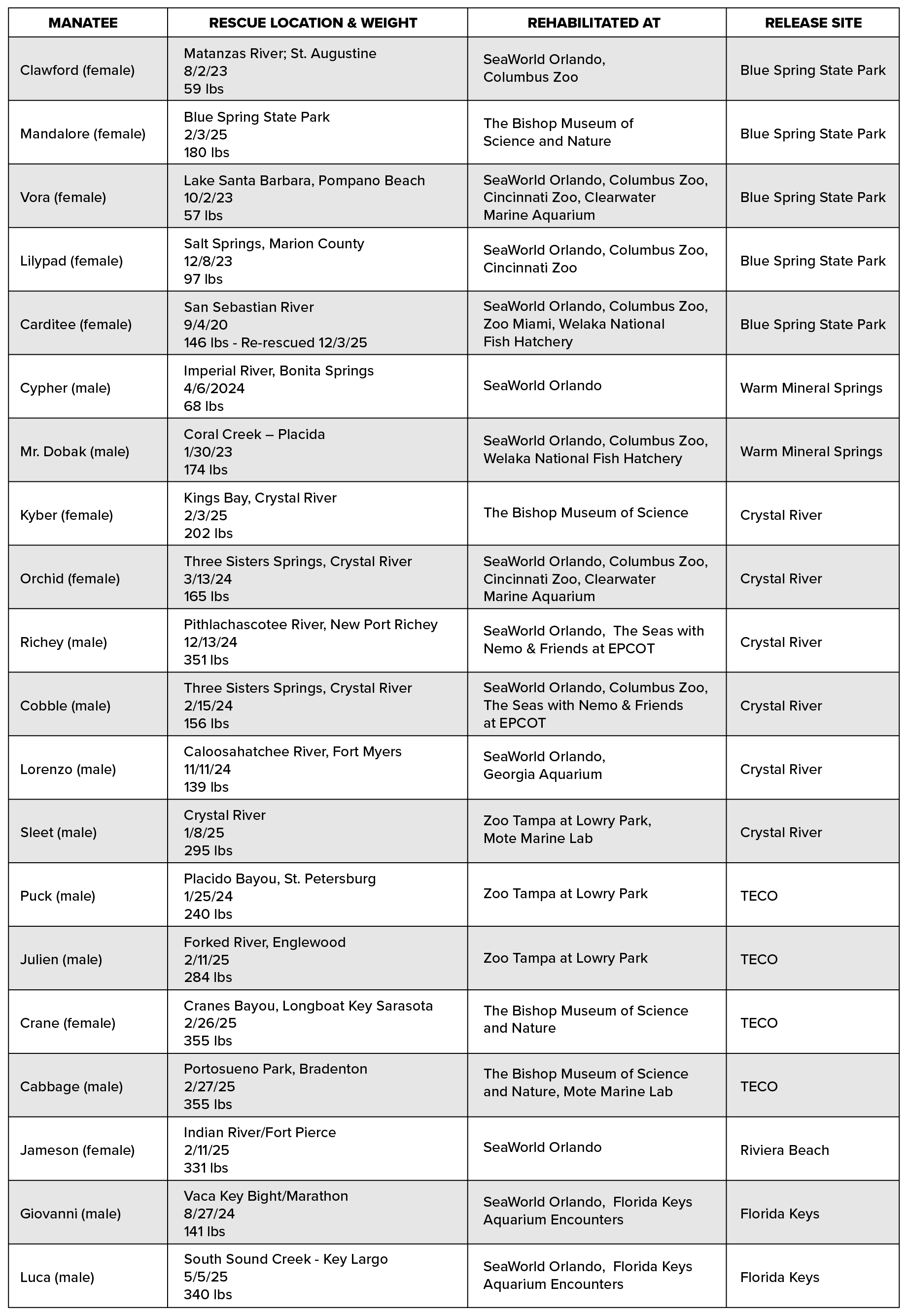
Manatees that were transferred back to Florida waters
##
Media Contacts:
Kelly Richmond, Florida Fish and Wildlife Conservation Commission, Kelly.Richmond@MyFWC.com
Stephanie Bechara, SeaWorld of Orlando, mediarelations@seaworld.org
Sandra Morrison, ZooTampa at Lowry Park, Sandra.Morrison@zootampa.org
Lesley Harris, Walt Disney World, WDW.Communications@disney.com
Marsha Strickhouser, Clearwater Marine Aquarium, mstrickhouser@cmaquarium.org
Paige Hale, Georgia Aquarium, phale@georgiaaquarium.org
Jen Fields, Columbus Zoo and Aquarium, Jen.Fields@columbuszoo.org
Michelle Curley, Cincinnati Zoo &Botanical Garden, Michelle.Curley@cincinnatizoo.org
Cora Berchem, Save the Manatee Club, cberchem@savethemanatee.org
Lanier Clegg, U.S. Fish and Wildlife Service, lanier_clegg@fws.gov